I built a daily grammar quiz because I'm still learning too
English is not my first language. Tagalog is.
But English was never far away. Growing up in the Philippines, it was everywhere: in our school books, on TV, on the signs at the grocery, in the directions on the street. I was reading English long before I ever felt comfortable speaking it.
Speaking it was a different story. I went to a public school, where everyone spoke Tagalog unless a teacher told us to use English. And if you spoke English too fluently, too often, outside of class, people noticed. You were maarte. Trying too hard. Trying to sound cool, or rich, like you thought you were better than everyone else.
So English was never really mine. It was the language of school. And I never felt confident in it, not when I spoke and especially not when I wrote. Every sentence came with the same quiet feeling: this is probably wrong.
In high school, I joined the school paper.
I was given topics to write about, and I'd hand in my piece, and then the chief editor would read it. And rewrite it. Not fix a few words here and there. Rewrite all of it, until it was basically a new story with my name somewhere near it.
I remember how embarrassing that felt. It wasn't that I didn't know what I wanted to say. I just didn't know how to put the words together. How to take what was in my head and tell it as a story, in plain English, the way it sounded when I imagined it.
Then I grew up, and the rules flipped. In college, English was the language of every lecture and every exam. When I started applying for jobs, every application and every interview was in English. The thing kids teased you for was suddenly the thing that decided whether you got hired.
Years ago, I was thinking about applying for tech jobs in Singapore. Someone told me, with the way I spoke English, there was no way I'd get a job there.
I was angry. Then, somewhere under the anger, something else showed up. It felt like a challenge. I wanted to prove them wrong. Not by arguing, but by getting better.
English has been around me my whole life. And for the last ten years, I've worked in it every day. I write code in it, I read documentation in it, I sit in meetings and send messages and argue about naming things in it. I'm a lot better than I used to be. But every now and then, a small word still stops me.
A or the? In or on? Is it fewer or less?
There's a reason those are the ones. Tagalog doesn't use a, an and the the way English does. And where English has in, on and at, we mostly have one little word: sa. So when I'm writing quickly, those are exactly the words that slip. Not the big, complicated grammar. The tiny words in between.
Sometimes Facebook shows me a memory of something I posted years ago, and I cringe a little. The grammar is all over the place. But I've started giving that version of me some credit. She posted it anyway. She kept writing anyway.
I think that's the thing I'm actually good at. Not English. Trying. Showing up again, even when I know I'll get something wrong, because the only way I've ever gotten good at anything is by practising until it stops being hard.
Recently, two things made that practice feel more urgent.
First, I started writing here. Publicly, with my name on it, for anyone to read. And every post I publish, there's a little voice asking: tama ba 'to? Is this right?
Second, I got a new job. Next week I start as a Documentation Engineer. Writing is no longer something I do on the side. It's the job. Developers all over the world will read what I write, and a lot of them, like me, will be reading it in their second or third language. Clear, correct English isn't a nice-to-have anymore. It's how I help people.
So I wanted to practise. Not a course, not a textbook. Something small I could do every day, the way I played Sudoku on LinkedIn every day until it finally clicked.
I couldn't find exactly what I wanted. So I built it.
It's called Tama ba?. In Tagalog, it means Is it right?
Every day there are five sentences. Each one has a single underlined word, and you decide: is it right, or does it need fixing? Sometimes it's wrong. Sometimes it's already correct, and that's the trick. You have to actually think about it every time, not just hunt for the mistake.
After each answer, a little card pops up and tells you why. That part matters most to me. Getting it right by luck doesn't teach you anything. Knowing the rule does.
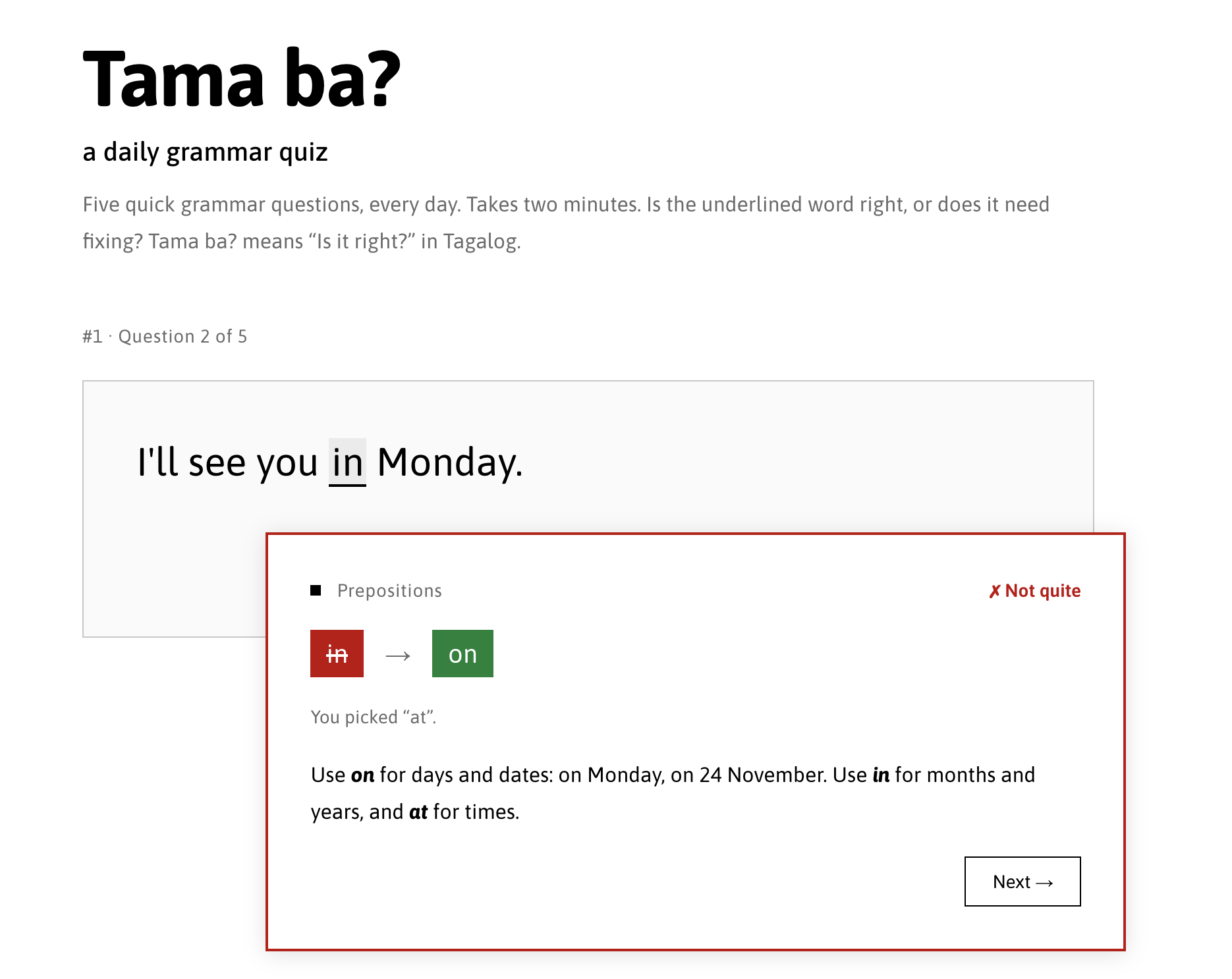
The design is borrowed from the grammar checkers I use every day: a sentence, an underlined word, and a suggestion card that pops up over it. Green when you're right, red when you're not. If you've ever had a squiggly line under something you wrote, it'll feel familiar.
The questions cover the small words that trip me up the most: a, an and the, in, on and at, tenses, plurals, and the words everyone mixes up, like their, there and they're. Everyday sentences about work, coffee, London and family. No textbook examples about Mr. Smith and his umbrella.
When you finish, you get your score, your streak, and a message. In Taglish, because of course:
- 5/5: Perfect! Ang galing mo!
- 4/5: Halos perfect!
- Not your day: Bawi bukas! (You'll get it back tomorrow.)
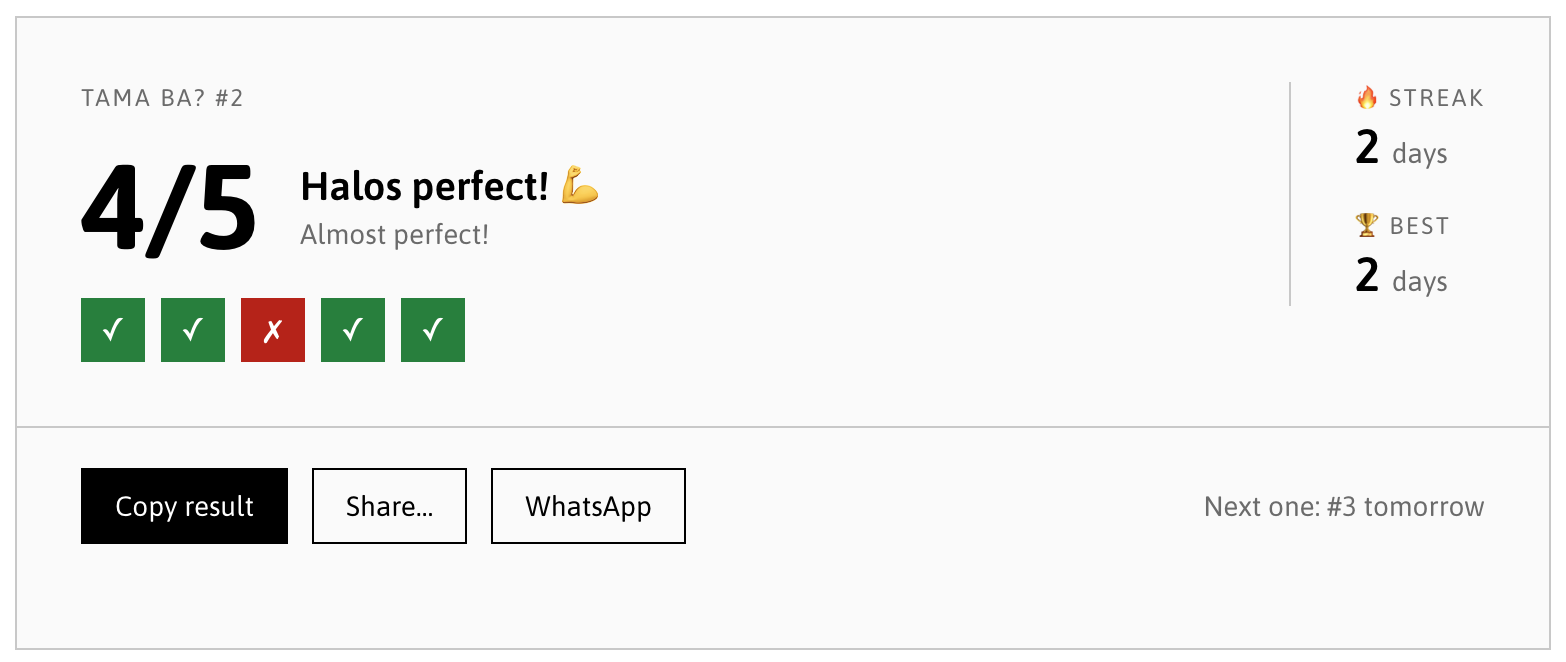
There's a share button too, so you can drop your score in the group chat. Everyone gets the same five questions on the same day, so you can compare. A new set appears at midnight wherever you are.
No accounts, no sign-ups, nothing to install. Your answers and your streak stay in your own browser. Nobody sees your mistakes but you. It's free, and it'll stay free.
There's an unspoken rule back home: if your English isn't perfect, don't bother. Don't post, don't speak up, because someone will screenshot your grammar and laugh at it.
I don't want to be part of that. I'd rather be the person who says it out loud: you're allowed to be bad at something while you get better at it. That goes for English, and honestly, for anything you're trying to get better at.
I didn't make Tama ba? because I've figured English out. I made it because I haven't, and I'd rather practise a little every day than keep quietly hoping nobody notices the small mistakes.
If English is your second language too, or your third, or even your first and you just want two minutes of practice with your coffee, come play. Tell me your score.
And if you were ever called maarte for speaking English, or told your English wasn't good enough: this one's for you. Practise out loud. Get it wrong. Try again tomorrow.
And if you ever catch a mistake in one of my posts, you know what to ask.
Tama ba?
Get notified when I post
No spam, just a note when something new is up.